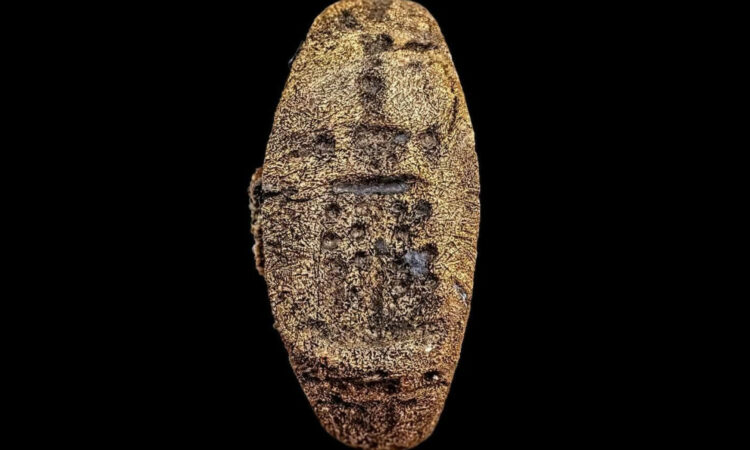



A nearly 2,000-year-old bronze ring depicting the famous Lighthouse of Alexandria has been discovered by archaeologists at the bottom of the Mediterranean Sea in Egypt. The object has been described as a special discovery by Egyptian authorities, as it is the first known case of the appearance of this monument on a signet ring. The discovery was announced by the Egyptian Ministry of Tourism and Antiquities and was made during underwater excavations in the area of ancient Alexandria, parts of which are now under the waters of the Mediterranean. The Lighthouse of Alexandria, also known as the Pharos Lighthouse, was one of the Seven Wonders of the Ancient World and one of the most important works of ancient engineering.
According to Hisham El-Lithi, secretary-general of Egypt's Supreme Council of Antiquities, the figure engraved on the ring resembles depictions of the lighthouse found on coins from the second century AD. However, the uniqueness of the object lies in the fact that until now no signet ring depicting this famous monument had been documented. The ring was discovered on the island of Antirhodos, part of the royal quarter of ancient Alexandria, in the area of the port known as Portus Magnus.
The location of the find is also of particular importance for the history of the city. On the island of Antirhodos there was a royal palace, described by the ancient Greek historian and geographer Strabo, who visited Egypt between 29 and 25 BC. According to Egyptian authorities, the ring may be an indication that the palace continued to be used in the second century AD, perhaps for administrative activities related to the management of the lighthouse. However, this remains a hypothesis that requires further study and does not constitute a definitive conclusion about the function of the palace at that time. Built on the island of Pharos, near ancient Alexandria, the lighthouse served as a landmark for ships approaching the city's port, one of the most important commercial and cultural centers of the Mediterranean.
The monument suffered extensive damage from earthquakes over the centuries and gradually collapsed. However, its remains and archaeological discoveries in the underwater area continue to help researchers reconstruct the history of ancient Alexandria. The discovery of the ring is part of a joint mission by the European Institute of Underwater Archaeology and the General Directorate of Underwater Archaeology under the Supreme Council of Antiquities of Egypt. The mission is excavating four areas of Alexandria's East Harbor, including the Temple of Isis, the royal palace and other sites on the island of Antirhodos, as well as Timonium, historically associated with Mark Antony.
During the research, objects from different periods have been discovered, from the fourth century BC to the fourth century AD. Among them are ceramic fragments, everyday utensils, amphorae and glass objects. Frank Goddio, director of the European Institute of Underwater Archaeology and head of the mission in Antirhodos, has assessed the scientific and archaeological importance of the findings. The Egyptian Minister of Tourism and Antiquities, Sherif Fathi, has also congratulated the experts for their work in researching and documenting the underwater remains, emphasizing that the discoveries help expand knowledge about the history and culture of Alexandria. Excavations in the Eastern Port continue, while after the completion of the current phase, the mission is expected to launch new underwater research in the Gulf of Abu Kir.