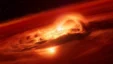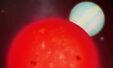



A radio signal detected in deep space has led astronomers to a major discovery: for the first time, researchers have reported radio emissions that appear to come directly from a planet outside the Solar System. It is Beta Pictoris b, a giant exoplanet located about 63 light-years from Earth and has a mass about 12 times that of Jupiter. The discovery was made with the help of the MeerKAT radio telescope in South Africa, which recorded repetitive and strongly circularly polarized radio emissions at frequencies from 0,85 to 3,5 GHz.
The significance of the discovery lies in the fact that the position of the source of these emissions coincides with the planet itself, and not with the star around which it orbits. This gives researchers the opportunity to directly investigate some of the physical properties of such a distant exoplanet. The signals are not related to a possible message from extraterrestrials. According to the scientific explanation, they are natural radio emissions associated with the planet's magnetic field. A similar phenomenon has also been observed on planets in the Solar System, especially Jupiter.
How can signals help in studying the planet?
Researchers believe this type of radiation could serve as a probe to study the magnetic field of Beta Pictoris b. The mechanism thought to be behind the emissions is called an electron cyclotron maser. It occurs when energetic electrons interact with a magnetic field and produce radio waves. The higher frequency at which the emission is detected can give scientists clues about the strength of the magnetic field in the area where the radiation is produced.
Based on this interpretation, the researchers estimate that the magnetic field in that region is at least about 1,25 kilogauss (kG). However, this value does not represent a direct measurement of the planet's entire magnetic field, but rather an estimated minimum limit for the area from which the radiation comes. The discovery could open new avenues for studying the magnetic fields of exoplanets and better understanding their physical properties, without the need for a spacecraft to travel to them.